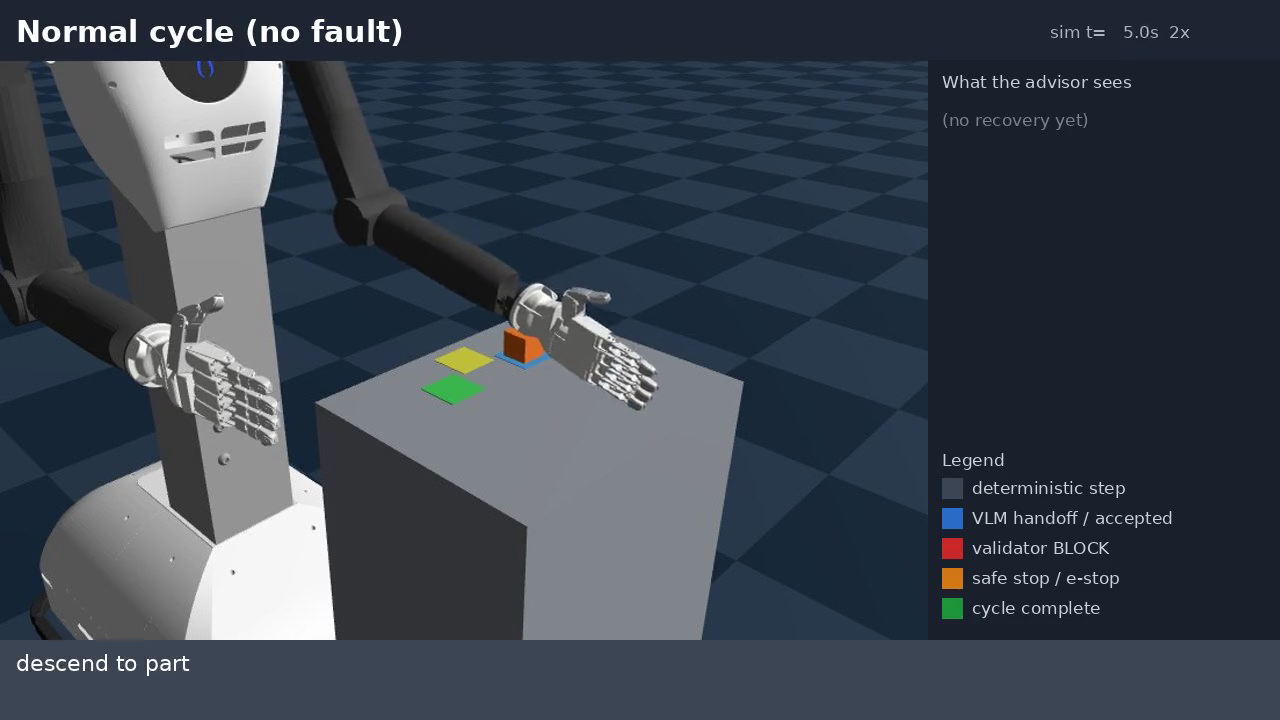
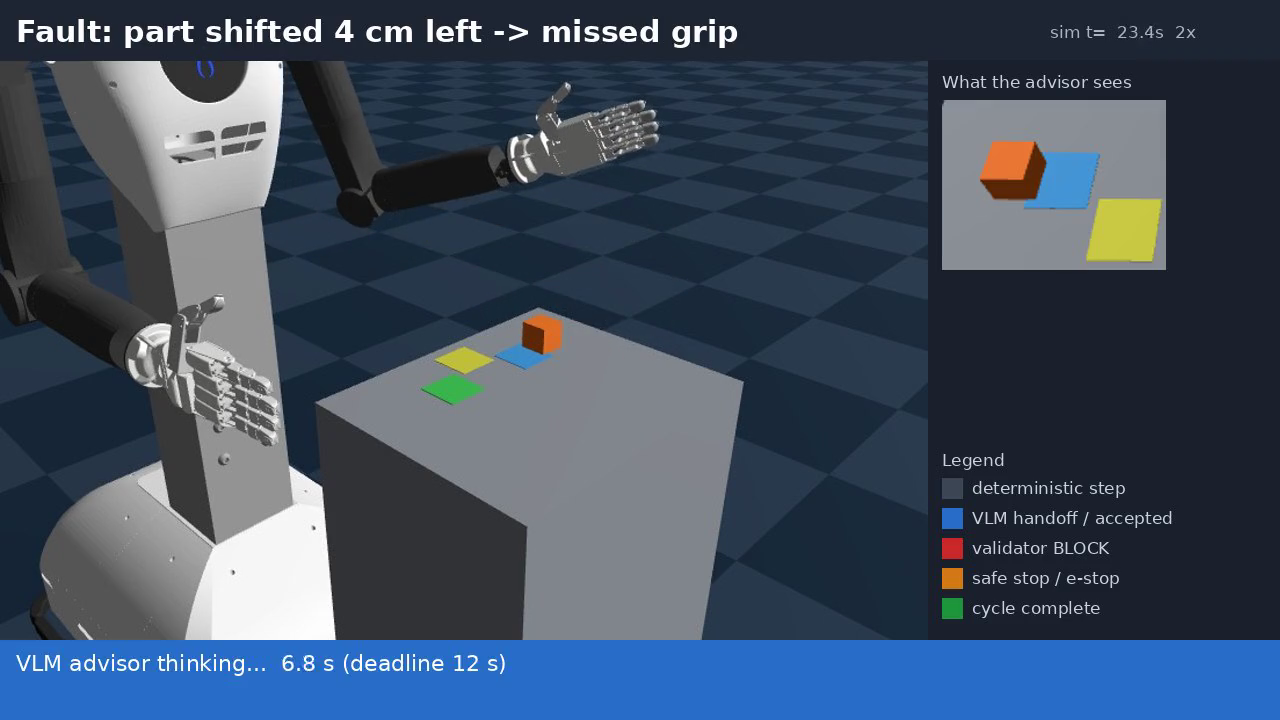
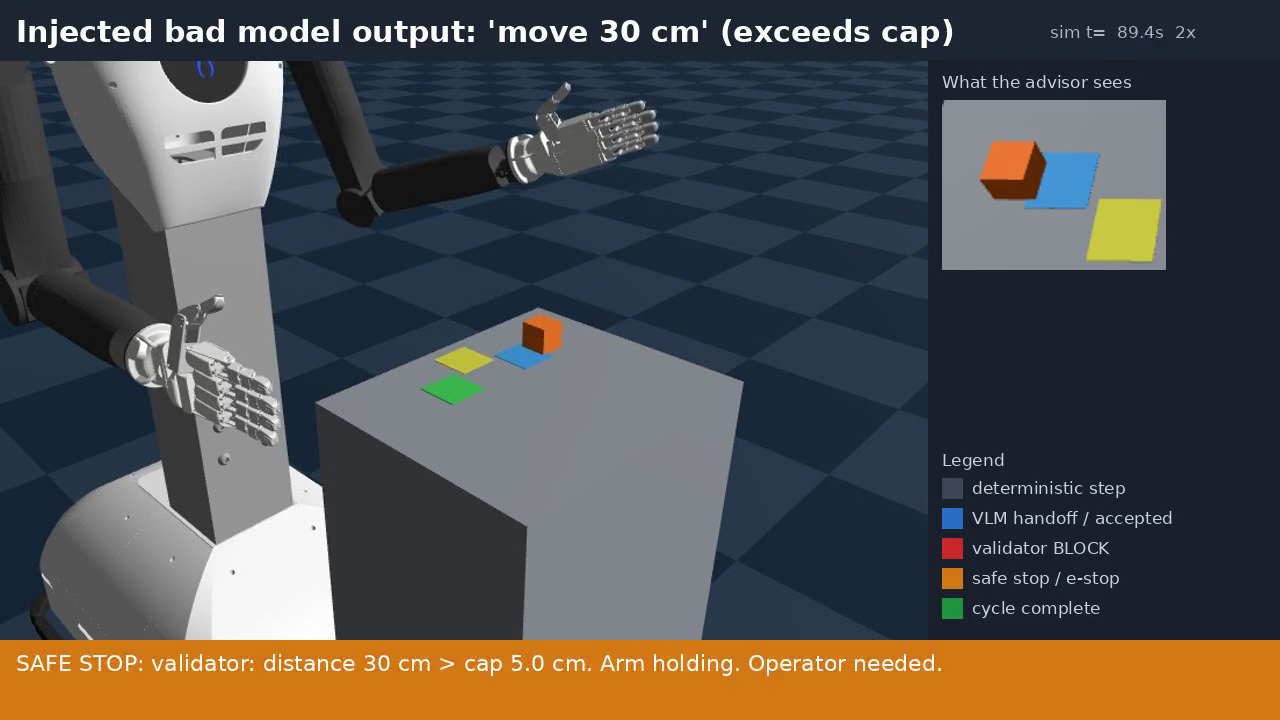
Build with AI: Smart Automation, Robotics, and Vision. Part A, idea 3: VLM-assisted control program fault recovery.
Demo, 1 min 47 s: normal cycle, scene faults, VLM recovery, validator blocks, safe stops, e-stop. Shown at 2x sim time. Direct mp4
The MH3 humanoid (official GDG-Hackathon Genesis template, headless on CPU) runs a pick-and-place cell as a deterministic py_trees behaviour tree. When a step fails, a recovery node takes the robot's head-camera frame and asks a small local vision-language model yes/no questions on depth-located crops. A fixed table turns the answers into JSON from a closed action set. A deterministic validator checks schema, allowed actions, a 5 cm distance cap, 2 retries, a 12 s deadline and an independent depth cross-check before any motion. Anything invalid, slow or unsafe ends in a safe stop. The model never commands motion.
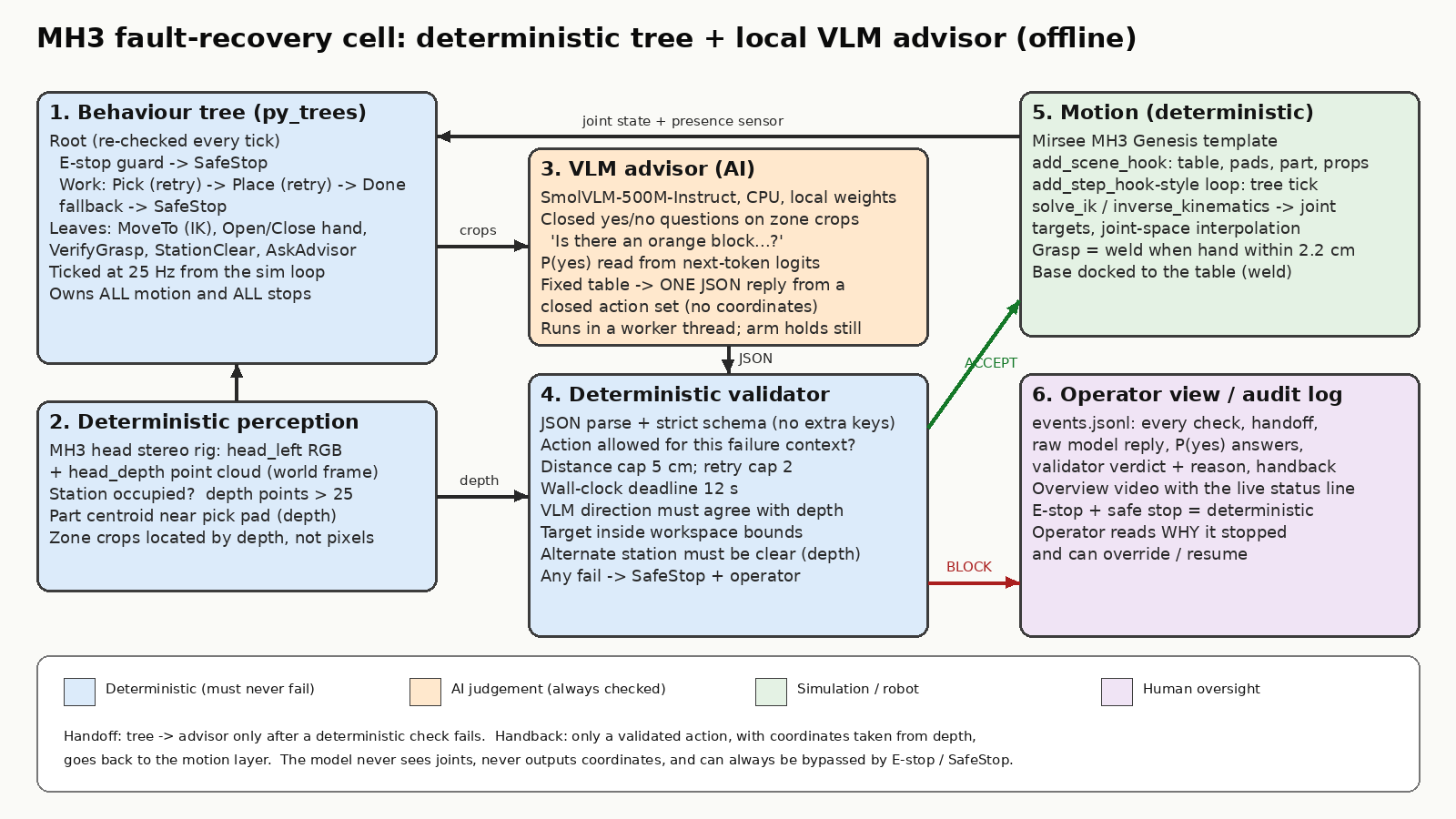
Eval suite, 56 episodes (52 with an injected fault: 36 scene faults and 16 bad-model-output faults, plus 4 nominal):
| Correct final outcome | 56 / 56 |
| Recovered and completed, no operator | 20 |
| Safe-stopped (all expected) | 32 |
| Validator blocks | 24 (16 injected bad output, 8 real proposals rejected by depth cross-checks) |
| VLM fault-class accuracy | 35 / 36 |
| VLM latency per call | median 4.04 s, p90 4.64 s, max 5.44 s |
Hardware: Intel Xeon, 8 threads, 16 GB RAM, no GPU, fully offline. Model: HuggingFaceTB/SmolVLM-500M-Instruct (Apache-2.0) on CPU. Simulator: Genesis 1.4.6 CPU with the MH3 template. In the recorded demo, rendering shared the CPU, so VLM latency was a median of 7.55 s there.
Built by Grok Bot for James Mills. The MH3 model and template are by HumanoidAppLab / Mirsee and are not redistributed here.